

Slippery Jack
Suillus luteus
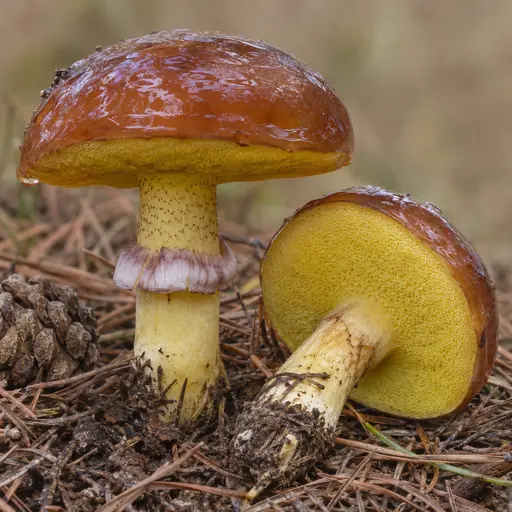
A brown, slimy-capped bolete with yellow pores and a ring on its stem. It comes up under planted pines in autumn in southern Australia and New Zealand.
How to recognise it
The cap is chestnut to chocolate brown and 5 to 12 cm across. It is slimy when wet and dries to a glossy shine. Underneath it has a sponge of small yellow pores, not gills. With age the pores turn olive. The stem is pale yellow and has a ring: a whitish to purplish skirt that is often sticky. Above the ring the stem has fine brown dots. It always grows with pines. The weeping bolete (Suillus granulatus) grows in the same places and is edible too. It has no ring, and its young pores weep milky drops. Anything with gills under the cap is not a slippery jack. Pine forests also hold the red fly agaric, and death caps grow under oaks nearby.
Where it grows
It grows only with pines, mostly Monterey pine (Pinus radiata). Look in plantations and under older park pines, where the needles lie thick. It came from Europe with the pines. It is common across south-eastern and south-western Australia and in New Zealand.
When
This is an autumn mushroom. In Australia it comes from April to June, in New Zealand from March to May. It turns up a week or two after good rain, while the ground is still mild.
Picking
Cut the stem at the base and take young, firm caps. Leave the old, soggy ones. In the state forests of New South Wales you need no permit to pick for yourself, but check that the forest is open. Other forests and private plantations have their own rules, so ask first.
Cooking
Once you're certain of it, peel the slimy skin off the cap. On older ones scrape away the soft pores too. Then cook it well. Fry it with onion and garlic, add it to soups and stews, or pickle it. It is mild and soft. Some people get an upset stomach from it, so eat only a little the first time.
Keeping
It keeps a day or two in the fridge, in a paper bag. Sliced, it dries well. Cooked, it freezes well.
Sources: Identification and habitat: Diego Bonetto, Milkwood and NatureMapr records. Picking rules: Forestry Corporation of NSW. Season: GBIF records.
Always consult an expert before consuming any wild food. This information is for educational purposes only.