

Pigface
Carpobrotus spp.
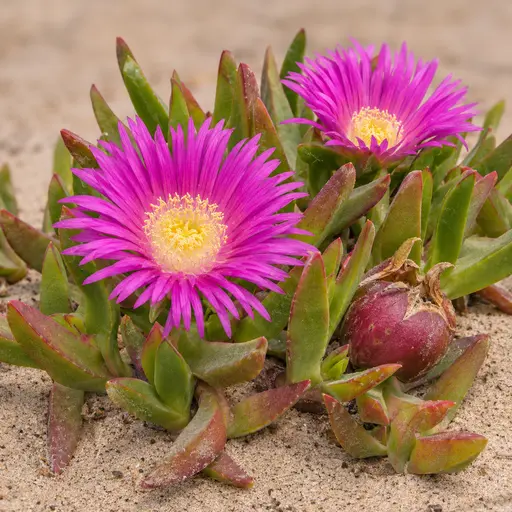
A creeping coastal succulent with thick, three-sided, salty leaves and a sweet red fruit. It grows on dunes and cliffs round the coasts of Australia and New Zealand.
How to recognise it
Pigface is a low, creeping succulent that spreads in thick mats over sand and rock. The stems root where they touch the ground. The leaves are thick, juicy and three-sided, like a bent finger, and mostly 3 to 10 cm long. The flowers are big and daisy-like, with many thin petals. The fruit is a fleshy knob 2 to 3 cm long, and it turns red or purple when ripe. In Australia the common natives are Ross's pigface or karkalla (Carpobrotus rossii) and the coastal pigface (Carpobrotus glaucescens). Their flowers are pink to purple. The South African sea fig (Carpobrotus edulis) has spread along the same coasts and crosses with the natives. Its flowers are bigger and yellow, turning pink with age. Its fruit is eaten too, so you don't need to tell them apart. In New Zealand nearly all pigface is introduced: the sea fig and the purple-flowered Chilean sea fig (Carpobrotus chilensis). The only native one (Carpobrotus glaucescens) is rare and known from just two places, the Coromandel Peninsula and Otama, so leave it. New Zealand's own ice plant, horokaka (Disphyma australe), looks like a small pigface. Its leaves are under 4 cm long and its flowers are 2 to 4 cm across. Leave it: it is native, and there is no good source for eating it. In southern Australia the round-leaved pigface (Disphyma crassifolium) has rounded leaves instead of three-sided ones. On every plant you pick, check that the leaves are thick and three-sided.
Where it grows
It grows on coastal dunes, cliffs and rocky shores, on sandy, salty ground. In Australia Ross's pigface grows along the southern coast, in Victoria, South Australia and Western Australia. The coastal pigface grows along the east coast, from Victoria to Queensland. The sea fig has spread along the southern and eastern coasts. In New Zealand you find the sea fig on dunes, cliff tops and roadside cuttings by the sea, all round the coast of both islands.
When
You can pick the leaves all year. The fruit ripens after the flowers fade, mostly in summer and autumn, from December to May. Most people see pigface in flower in spring, but the fruit comes later. In a cool summer the fruit may hardly ripen.
Picking
Pick fresh, plump leaves and ripe fruit, and only a little from each plant. Don't squash the plant: it holds the dunes together. Leave some fruit for the birds that spread the seed, and stay on the tracks across dunes. In Australian national parks and nature reserves you may not pick plants. In New Zealand the sea fig is a pest plant, so don't carry cuttings or fruit to a new place. Skip plants near outfalls, car parks and dog tracks.
Cooking
Once you're certain of it, squeeze the pulp of a ripe fruit out of its skin and eat it raw. It tastes of strawberry, kiwi fruit and fig, with a salty edge. The sea fig's fruit is tart. The fruit also makes jam, chutney and pickle. The leaves are juicy and salty. Eat them raw in salads, stir-fry them or quick-pickle them. A little goes a long way.
Keeping
Eat the fruit and leaves fresh, within a day or two. A quick pickle keeps in the fridge. Jam goes in a sterilised jar in the fridge.
Sources: Identification and range: VicFlora, Weeds Australia, NZ Plant Conservation Network and Flora of New Zealand. Picking and eating: Milkwood, SBS and NSW National Parks. Season: SBS and GBIF records.
Always consult an expert before consuming any wild food. This information is for educational purposes only.