

Wild Fennel
Foeniculum vulgare
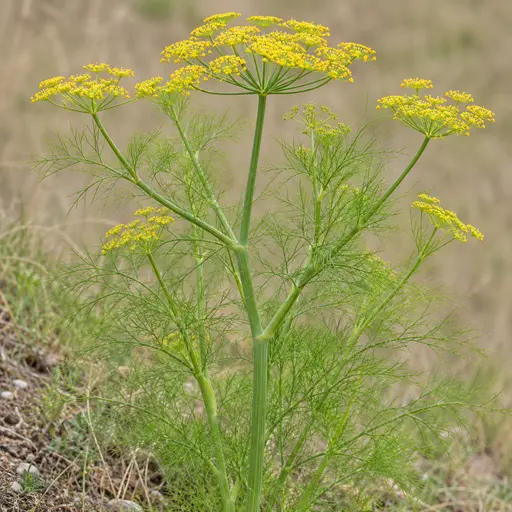
A tall, feathery herb with yellow flower heads and a strong smell of aniseed. It grows wild along roadsides, railway lines and waste ground in southern Australia and New Zealand.
How to recognise it
Wild fennel is a tall plant, 1 to 2.5 m high. Its leaves are split into very fine, thread-like strands, like green feathers. In summer it carries flat heads of tiny yellow flowers. A crushed frond smells strongly of aniseed. Take great care here: hemlock (Conium maculatum) is a common weed in both countries and it is deadly. All of it is poisonous, the seeds and young plants most of all. It often grows right beside fennel, and its seeds have been mistaken for aniseed. Hemlock has white flowers, not yellow. Its stem is smooth and hairless with purple to reddish-brown blotches, and fennel's has none. Its leaf segments are broader, and crushed leaves smell musty. People describe that smell in different ways, and aniseed on your fingers can fool you, so never go by smell alone. Check the flowers, the stem and the leaves every time. Wild carrot (Daucus carota) has white flowers and a hairy stem, and its leaves smell of carrot. Bishop's weed (Ammi majus) has white flowers and no blotches, and it is not safe to eat either. Pick only a plant with fresh, thread-fine fronds that smell of aniseed and a stem with no purple at all. If any one thing is off, leave it.
Where it grows
It grows along roadsides and railway lines, in drains, on waste ground, on creek banks and on dry coasts. It likes open, sunny places with poor, disturbed soil. It came from Europe and Asia. In Australia it is common in the south-east and around Adelaide and Hobart. It also grows along the south-west coast of Western Australia. In New Zealand it grows all over the country.
When
New fronds come up in spring, from September. The yellow flowers open from November and last into autumn. The seeds ripen from late summer and stay on the plant through winter. In cold places the plant dies back to its root in winter.
Picking
Pick the young fronds, the flower heads and the seeds by hand. Take them only from plants you have checked one by one. In winter, dry fennel and dry hemlock stalks can be hard to tell apart. So pick seed only from plants you knew in leaf or flower, and leave any dry stalk you cannot crush. Avoid busy roads and any roadside or railway line that may be sprayed. Wash the green parts well. In Tasmania and Victoria fennel is a declared weed, so it must not be sold or spread. If you think someone has eaten hemlock, keep a piece of the plant and ring the Poisons Information Centre on 13 11 26 in Australia or 0800 764 766 in New Zealand.
Cooking
Once you're certain of it, use the young fronds like a fresh herb. Chop them into salads, fish dishes, pesto, butter or green oil, or stir them in at the end of cooking. The yellow flowers and the pollen make a fine finishing touch on pasta. The dry seeds go into bread, sausages, stuffings and tea. The young stems can be peeled and eaten raw.
Keeping
The fronds keep a few days in the fridge, wrapped in a damp cloth. Butter and green oil made with them keep chilled. Dry the seeds in a paper bag, then store them in a jar. Keep the pollen in an airtight container, somewhere dry and dark.
Sources: Identification and range: Weeds Australia, VicFlora, Biosecurity Tasmania, Weedbusters and Flora of New Zealand. Hemlock: Weeds Australia, HerbiGuide and Weedbusters. Kitchen use: Diego Bonetto and The Spinoff. Season: GBIF records.
Always consult an expert before consuming any wild food. This information is for educational purposes only.