

Wood Ear
Auricularia cornea
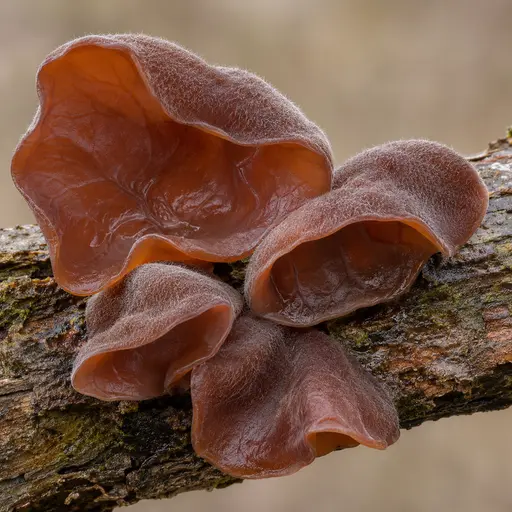
A soft, rubbery fungus shaped like an ear, brown with a velvety, grey-haired outside. It grows on dead wood in damp forest in New Zealand and eastern Australia.
How to recognise it
Wood ear is a soft, rubbery fungus shaped like a small ear or cup. It grows up to about 9 cm across. The colour runs from reddish brown to dark brown, and it is a little see-through when wet. The outside is covered in fine, pale grey hairs, like velvet. The inside is smooth and shiny, sometimes with a few veins. It has no real stem and sits sideways on the wood. It grows in clusters on dead wood and never straight out of the soil. When it dries it shrinks to a hard, black crust, and it swells up again after rain. The tripe fungus (Auricularia mesenterica) grows in Australia and is a close relative. It is paler and hairier, with bands of colour and a wrinkled, purplish underside. Other jelly fungi grow on dead wood too, such as the lobed Tremella and the smooth, glossy Exidia. They have no velvety hairs and no ear shape. True cup fungi are much more brittle than wood ear. None of these look-alikes is known to be poisonous. They are just bland or tough. Check three things on every piece you pick: it grows on wood, it feels rubbery and the outside is velvety. If one is missing, leave it.
Where it grows
It grows on dead wood of broadleaf trees. In New Zealand look on fallen branches and logs in native forest, on trees such as mahoe, pukatea, tawa and karaka. Most finds are in the North Island, but it turns up in the South Island too. In Australia it grows in the warm, wet forests of Queensland and New South Wales. It also grows on dying trees in suburban gardens. Māori call it hakeke, and from the 1870s it was dried and shipped to China.
When
It can fruit all year, but most finds are in autumn and winter. In New Zealand that means April to August, with the most from April to July. In Australia most finds are from March to July. It swells up in wet weather and shrivels in dry spells, so go when the wood is wet.
Picking
Cut it off the wood with a knife and take only soft, plump pieces. Skip any that are slimy or falling apart. Leave some in every patch. Much of New Zealand's native forest is conservation land, so ask the local Department of Conservation office before you pick. In most Australian national parks you may not pick fungi to eat. On private land, ask the owner.
Cooking
Once you're certain of it, rinse it and trim off the part that was stuck to the wood. Cook it well: simmer or stir-fry it for at least 15 to 20 minutes. It has almost no taste, but it stays slippery and crunchy. That suits soups and stir-fries. Māori steamed it in an earth oven and ate it with puha (sow thistle) and potatoes.
Keeping
Fresh, it keeps three to five days in the fridge. Dry it until it is crisp and keep it in a jar. In water it swells up to several times its size. Cook it before you freeze it, or it turns slimy when it thaws.
Sources: Identification and range: Landcare Research fungal guide, Biota of NZ, Australian Fungi blog and Australian Geographic. Look-alikes: Woodland Trust. History: Te Ara. Cooking and keeping: Practical Self Reliance. Picking rules: Fungimap. Season: GBIF records.
Always consult an expert before consuming any wild food. This information is for educational purposes only.