

Nasturtium
Tropaeolum majus
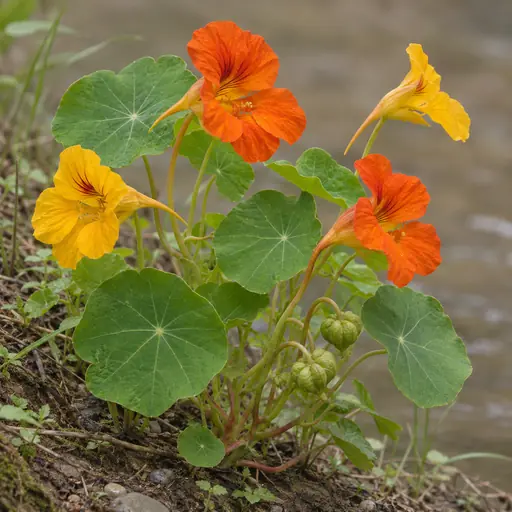
A trailing garden plant with round, umbrella-like leaves and bright orange, yellow or red flowers. It has gone wild on coasts, roadsides and creek banks in southern Australia and New Zealand, and the leaves, flowers and green seeds all taste peppery.
How to recognise it
Nasturtium sprawls along the ground or climbs over fences and shrubs. The leaves are round and a little wavy at the edge, usually 4 to 15 cm across. They look like small umbrellas: the stalk joins the middle of the underside, and seven to ten veins fan out from it like spokes. The flowers are trumpet-shaped, about 3 to 7 cm across, in cream, yellow, orange or red. Each has a long spur at the back. After the flowers come green, three-lobed fruits about 1 cm wide. Those are the seeds. Crush a leaf and it has a peppery smell, like watercress. Wild taro (Colocasia esculenta) also grows on creek banks. Its leaves are 15 to 60 cm long and arrow-shaped with a notch at the base, and the plant contains calcium oxalate and can irritate the skin, so leave it. The flame creeper (Tropaeolum speciosum) is a different climber, with leaves split into five or six fingers and small scarlet flowers. Leave that too. Check the leaf and the flower together on every plant you pick.
Where it grows
It grows on coastal dunes and banks and along roadsides and creek banks. You also find it in hedges and old gardens and near rubbish dumps where garden waste has been tipped. It copes with salt, wind, poor soil and some shade. It came from the Andes and escaped from gardens. In Australia it has gone wild in the southern states, in Victoria mostly near the coast on sandy soil. In New Zealand it has lived wild for more than a hundred years.
When
It flowers mostly in spring. The flowers start in July or August in Western Australia and on warm coasts, in September in Victoria and in October in New Zealand. They carry on through summer and into autumn. The green seed pods follow the flowers, from late spring to autumn.
Picking
Pick young leaves, open flowers and plump green seed pods by hand. Take only plants you are sure are nasturtium. Avoid garden beds and verges that may be sprayed, busy roads and places where dogs go. Wash everything well. In parts of both countries it counts as an environmental weed, because it smothers low plants on creek banks and bush edges. Pieces of stem take root easily, so don't tip scraps in the bush or on a creek bank.
Cooking
Once you're certain of it, use the young leaves in salads, sandwiches, pesto or soup. They taste peppery, like watercress. The flowers are edible too and look lovely on salads, cakes and cheese. For "poor man's capers", pick the green seed pods while they are still firm and pickle them in salted vinegar. Leave them a few weeks before you eat them.
Keeping
The leaves and flowers wilt quickly. Keep them in the fridge, wrapped in a damp cloth, and use them within a day or two. Pickled pods keep for several months in a jar. Once the jar is open, keep it in the fridge and eat them within a month.
Sources: Identification and range: HerbiGuide, WeedScan, VicFlora, Weedbusters and NZ Plant Conservation Network. Wild taro: HerbiGuide. Kitchen use: Diggers and Larder Love. Season: GBIF records and Flora of New Zealand.
Always consult an expert before consuming any wild food. This information is for educational purposes only.