

Lilly Pilly
Syzygium smithii
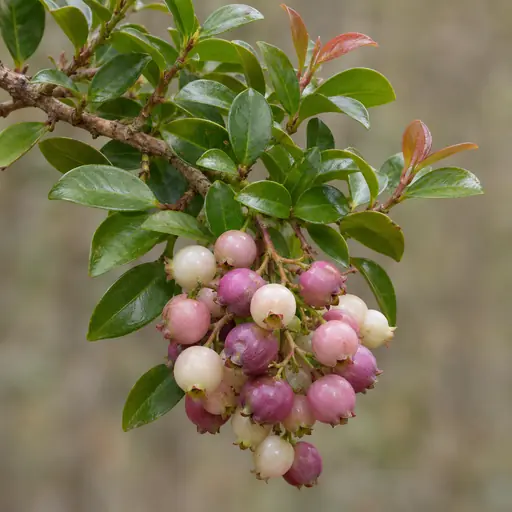
A glossy-leaved rainforest tree with pink new growth and small white to mauve berries. It grows wild on the east coast of Australia and is planted in streets and gardens.
How to recognise it
Lilly pilly is a tree with dark, glossy, pointed leaves that sit in pairs along the twig. The leaves have tiny oil dots on the underside and smell strong when you crush them. The new growth is pink or reddish. In spring and summer it carries fluffy clusters of cream-white flowers. The fruit is a round berry 1 to 2 cm across, often a little flattened, with a small hollow at the top. It is white, pink or pale mauve when ripe, and it holds one large, hard seed. Many other lilly pillies are planted too. The brush cherry (Syzygium australe), the riberry (Syzygium luehmannii), the magenta lilly pilly (Syzygium paniculatum) and the blue lilly pilly (Syzygium oleosum) have crimson, hot pink, magenta or blue fruit. They are eaten as well. The look-alike to watch is the tree privet (Ligustrum lucidum), a common weed with glossy leaves in pairs too. Its berries are black, and its new leaves are not reddish. Its leaves and berries are poisonous. In New Zealand the rare native swamp maire (Syzygium maire) has deep crimson fruit, so leave it. On every tree you pick, crush a leaf and check for the strong smell. If the berries are black, it is not a lilly pilly.
Where it grows
In Australia it is a rainforest tree. It grows wild along the east coast, from north Queensland through New South Wales to Wilsons Promontory in Victoria, and on King Island. It is also planted widely in streets, parks and hedges, much further south and west. In New Zealand it is called monkey apple. It has escaped from gardens and grows wild in forest and scrub, mostly in the North Island.
When
The flowers come in spring and summer, and the fruit follows. In Australia the fruit ripens from autumn into winter, mostly from March to August. In New Zealand it is ripe from late summer to autumn, roughly February to May. A ripe berry comes off the stem easily.
Picking
Pick ripe berries that come off the stem easily. The tree has no thorns. Leave some for the birds. In Australian national parks you may not pick plants. In New Zealand monkey apple is a pest plant: you may not sell or spread it, and in Auckland you may not plant it, so don't carry fruit or seeds to a new place. Street trees can be sprayed and dogs visit them, so wash the fruit well. If new shoots are covered in bright yellow powder (myrtle rust), don't touch it and don't carry any plant material away.
Cooking
Once you're certain of it, eat the berries fresh. They are crisp and juicy, a bit like a watery apple, mildly sour and not very strong in taste. Spit out the hard seed. They suit jam and pickles better than eating by the handful. You can also stew them and bake them into muffins, in place of blueberries.
Keeping
The berries are best within a few days, kept in the fridge. Jam and pickles keep in sterilised jars.
Sources: Identification and range: ANPSA, NZ Plant Conservation Network, Manaaki Whenua NZ Myrtaceae key and Wikipedia. Pest rules and look-alikes: Auckland Council. Privet: Port Macquarie-Hastings Council weed profile. Myrtle rust: Auckland Council. Kitchen: Tucker Bush and Botanic Gardens of South Australia.
Always consult an expert before consuming any wild food. This information is for educational purposes only.