

Native Raspberry
Rubus parvifolius
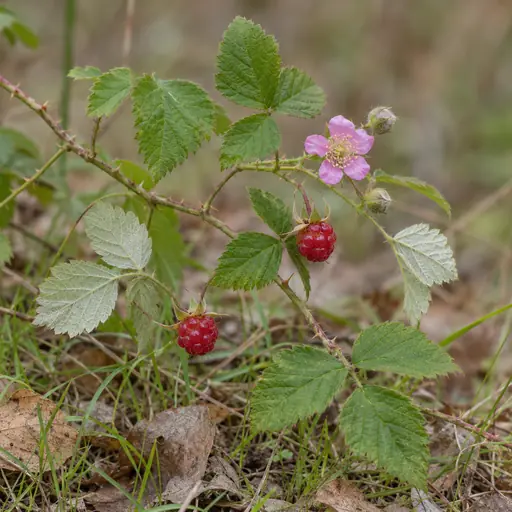
A prickly scrambler of south-eastern Australia with small, wrinkled leaves and pink flowers. In summer it carries small red berries that look like tiny raspberries.
How to recognise it
Native raspberry is a scrambling shrub. Its stems are about 1 m long and trail over rocks and other plants. They are finely hairy and have small, curved prickles. Each leaf is divided into three leaflets, sometimes five. The leaflets are 1 to 4 cm long, with toothed edges, a wrinkled green top and a white, woolly underside. The end leaflet is the biggest. The flowers are pink to red and sit in short clusters at the tips. The berry is a round cluster of tiny beads, about 1 cm across, and it ripens red. Blackberry (Rubus fruticosus) looks like a bigger, tougher version. It forms thick thickets, its leaves usually have five leaflets of similar size and its berries ripen black. Blackberries are edible, but blackberry is a declared weed in every state and territory. Jerusalem cherry (Solanum pseudocapsicum) grows at the edges of wet forest and has round, shiny red or orange berries. All parts of it are poisonous, especially the berries. Its leaves are smooth and lance-shaped, and each berry is a single smooth ball. Check the curved prickles, the divided leaves and the raspberry-like berry on every plant you pick.
Where it grows
It grows in the cooler, wetter parts of eastern and south-eastern Australia: Queensland, New South Wales, the ACT, Victoria, South Australia and Tasmania. It is native there. Look in moist forest, creek-side scrub and woodland, from near sea level up to the subalpine zone, often scrambling among rocks. It likes dappled shade and takes frost. It is rare in the drier forests.
When
The pink flowers open from about November to February. Ripe red berries come from December to March, mostly in January and February. Some hang on into April.
Picking
Pick only ripe red berries and leave the green ones. The prickles are sharp, so wear long sleeves or gloves. It is a native plant. In the national parks of New South Wales it is against the law to pick or collect plants, and other states have their own rules. So check before you pick in any park or reserve. On private land, ask the owner. Skip berries beside tracks and roads where blackberry has been sprayed. Wash the berries before you eat them.
Cooking
Once you're certain of it, eat the ripe berries fresh or cook them. They taste a bit like raspberries, but less sweet. Aboriginal communities in south-eastern Australia ate the red fruit long before the settlers did. The settlers made jam and pies from it. You can make jam, a sauce or a pie filling from the berries.
Keeping
The berries are soft and keep a day or two in the fridge. Freeze them on a tray and then bag them, and they last much longer. Jam keeps for months.
Sources: Identification and range: VicFlora, PlantNET and Castlemaine Flora. Blackberry: Weeds Australia. Jerusalem cherry: the NZ Department of Conservation weed database and the DELTA Solanum key. Food use: Australian National Botanic Gardens. Picking rules: NSW National Parks. Season: GBIF and iNaturalist records.
Always consult an expert before consuming any wild food. This information is for educational purposes only.