

Sow Thistle (Puha)
Sonchus oleraceus
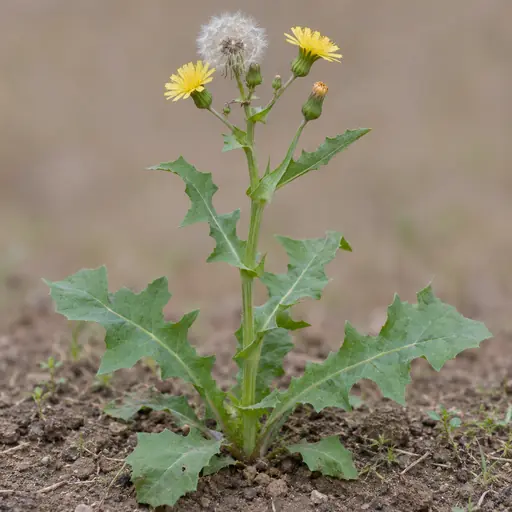
A soft weed with deeply cut leaves, milky sap and small yellow flowers like tiny dandelions. It is the puha of the New Zealand boil-up and grows in gardens and on waste ground in both countries.
How to recognise it
Sow thistle is a soft, hairless plant. It starts as a rosette of deeply cut leaves, often with a bigger lobe at the tip. At the base each leaf has two pointed lobes that clasp the stem, like ears. The stem is hollow and grows up to about a metre. It carries small yellow heads like tiny dandelions, several to a stalk. After the flowers come fluffy white seed heads. Break a leaf or the stem and white, sticky sap oozes out. Prickly sow thistle (Sonchus asper) is a close relative and is eaten too. Its leaves are spinier and its lobes rounder. Dandelion (Taraxacum officinale) is edible as well. It has one flower on a hollow, leafless stalk. Prickly lettuce (Lactuca serriola) has a row of small spines down the underside of each leaf's midrib and is listed as possibly poisonous, so leave it. Petty spurge (Euphorbia peplus) has milky sap too, and it burns skin and eyes. Its leaves are small, smooth and oval, never cut into lobes. Sap alone is not enough, because many plants have it. Check the stem and the leaf shape of every plant you pick.
Where it grows
It grows in gardens, vegetable beds, paddock and crop edges, on roadsides, in cracks in paving and on waste ground. It likes open, disturbed, fertile soil. It came from Europe and Asia and is now a weed all over Australia and New Zealand. The two kinds you will meet, sow thistle (Sonchus oleraceus) and prickly sow thistle (Sonchus asper), are both introduced. Both are eaten.
When
It grows nearly all year, because it sprouts whenever the ground is moist. In New Zealand the best picking is from early spring to midsummer, while the leaves are young. In Australia plants come up after any good rain. Once a plant flowers, its leaves turn bitter and tough.
Picking
Pick young leaves and tender tips with your fingers or scissors, and leave the root so the plant grows again. Choose plants that have not flowered yet, because old leaves turn bitter and tough. Avoid roadsides, paddocks and garden beds that may have been sprayed with weed killer. Rinse the leaves well. In New Zealand the native shore puha (Sonchus kirkii) grows on coastal cliffs. It is rare and declining, so leave it where it grows.
Cooking
Once you're certain of it, eat the young leaves raw in salads or cook them like spinach. Older leaves are bitter, so cook those. Rub the leaves in a bowl of cold water first, and much of the bitterness goes. In New Zealand puha is boiled with pork and other meat in a boil-up. In Greece it is boiled briefly and dressed with oil, lemon and salt. The prickles of prickly sow thistle soften when cooked. The yellow flowers and the young stems are edible too.
Keeping
Sow thistle wilts fast. Keep the leaves in the fridge, wrapped in a damp cloth, and use them within a day or two. Blanched and squeezed dry, they freeze well.
Sources: Identification and range: WeedScan, HerbiGuide, Massey University weeds database, Flora of New Zealand and NZ Plant Conservation Network. Use: Te Ara, Herb Federation of New Zealand and Diego Bonetto. Prickly lettuce: HerbiGuide. Petty spurge: Queensland Poisons Information Centre. Season: GBIF records.
Always consult an expert before consuming any wild food. This information is for educational purposes only.