

Australian Chanterelle
Cantharellus concinnus
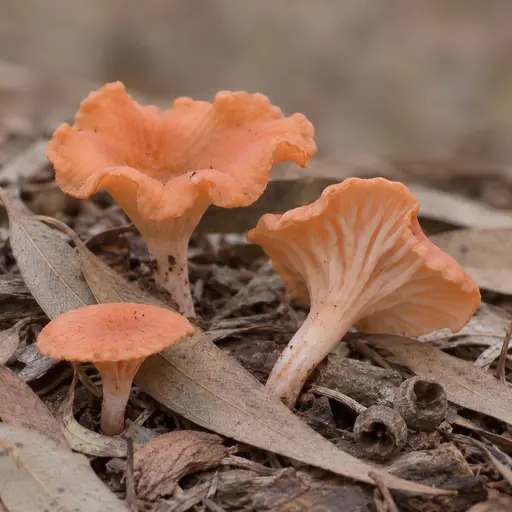
Australia's own chanterelle: a small apricot to pinkish-orange funnel with blunt, forked ridges underneath. It hides in the leaf litter of damp eucalypt forests from summer into autumn.
How to recognise it
The cap is apricot, yellow or pinkish orange and only 1.5 to 4 cm across. Young caps are flat. They soon become a shallow funnel with a wavy edge. Underneath there are no true gills, only blunt, shallow ridges. They fork near the edge, run down onto the stem and are paler than the cap. The stem is whitish pink and often twisted. It is as long as the leaf litter is deep, up to about 6 cm. The flesh is solid and pale. It smells faintly of apricots. The poisonous Austropaxillus also makes yellow-brown funnels under eucalypts, but it has crowded, sharp gills. Anything with thin, sharp gills, a cobweb-like veil or growing on wood is not a chanterelle.
Where it grows
It grows on the ground among leaf litter, in the wetter parts of eucalypt forests and woodlands and in coastal heath. She-oaks are often nearby. It also grows under southern beech. It comes up in groups, but the caps are often half buried, so look closely. You find it from south-east Queensland through New South Wales and Victoria to Tasmania. It also grows in the karri and wetter jarrah forests of the south-west.
When
It comes up after warm, soaking rain, from December to June. Most appear from late summer into autumn. A dry spell stops it. It also seems to stay away from ground that burnt recently.
Picking
Cut it at the base and leave the small ones to grow. Picking is not allowed in national parks. In state forests you can usually pick a little for yourself, but check the local rules first. Little is known about how common it is, so take only what you will eat.
Cooking
Once you're certain of it, cook it. It tastes milder than the European chanterelle. Some people find it almost bland. Fry it slowly in butter until the water has gone. Then add it to eggs, pasta or risotto. It is small, so gather a handful. Australia's main foraging guide still counts it among the less documented edibles, so try only a little the first time.
Keeping
It keeps two or three days in the fridge, in a paper bag. Fried first, it freezes well. Dried, it turns tough.
Sources: Identification, range and edibility: One Hundred and One Forest Fungi of Eastern Australia (Lucidcentral), NatureMapr and Wikipedia. Edible but little documented: Wild Mushrooming (Pouliot and May). Austropaxillus: Western Australian fungus records. Season: GBIF records.
Always consult an expert before consuming any wild food. This information is for educational purposes only.