

Native Hedgehog
Hydnum crocidens
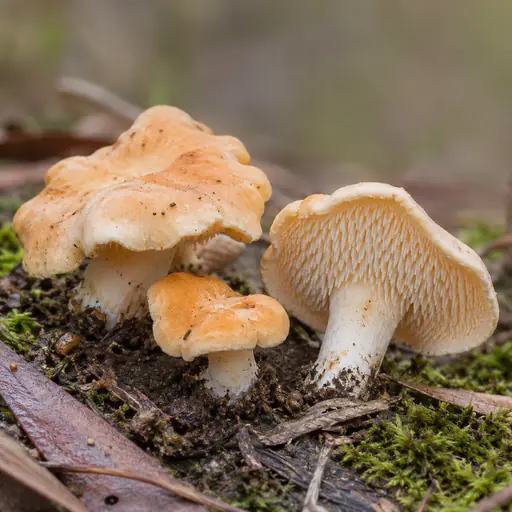
The native hedgehog fungus of Australia and New Zealand: a small cream to orange cap with soft spines underneath instead of gills. It hides in the leaf litter of native forests through winter.
How to recognise it
The cap is small, usually 1 to 6 cm across. In New Zealand it is white to cream. In Australia it is often dull orange, apricot or chestnut brown. It is flat or a little sunken, with a wavy edge. It is often lopsided. Turn it over. Underneath there are crowded, soft spines about 3 to 5 mm long, not gills. They are creamy white and break off easily. The stem is short and solid, up to 4 cm long and the same colour as the cap. The flesh is white. Scientists count it as a group of about six species, all very like the European hedgehog. The tooth fungi Hydnellum and Phellodon also have spines under the cap. They have small, dull brown caps and tough, woody or leathery flesh. They are too tough to eat. The Australian chanterelle has blunt ridges, not spines. Anything with gills or pores under the cap is not a hedgehog.
Where it grows
It grows on the ground, in leaf litter and moss, under native trees. Look in eucalypt forest such as karri, jarrah and messmate. It also grows in coastal woodland and tea-tree scrub. In New Zealand it grows under native trees and shrubs, often with tea-tree. It comes up in groups and sometimes in rings. The caps are often small and half buried, so look closely. You find it across eastern Australia and Tasmania. It also grows in Western Australia and throughout New Zealand.
When
It comes through winter and into early spring. Most come from June to September. A few turn up as early as May. In the jarrah forests around Perth August is the best month. They resist decay, so they can stay in the forest for weeks.
Picking
Cut it at the base and leave the tiny ones to grow. Picking is not allowed in national parks. In New Zealand you need the Department of Conservation's permission on its land. Elsewhere check the local rules first.
Cooking
Once you're certain of it, cook it well. Australia's main foraging guide counts the native hedgehog among its ten wild edibles. Try it simmered in chicken stock and red wine until the liquid has halved. Then add chicken, vegetables and a little cream. New Zealand's Hidden Forest database lists its edibility as unknown. Eat only a little the first time.
Keeping
It keeps well in the fridge, in a bag. It is slow to rot and insects leave it alone.
Sources: Identification and range: One Hundred and One Forest Fungi of Eastern Australia (Lucidcentral), Western Australia's Department of Biodiversity, Conservation and Attractions and Landcare Research (New Zealand). Edibility: Wild Mushrooming (Pouliot and May, reviewed on MykoWeb), a Western Australian forager's blog and Hidden Forest. Tooth fungi: Fungimap and Wikipedia. Picking rules: SBS, Gourmet Traveller and the Department of Conservation. Season: GBIF records.
Always consult an expert before consuming any wild food. This information is for educational purposes only.