

Cherry Plum
Prunus cerasifera
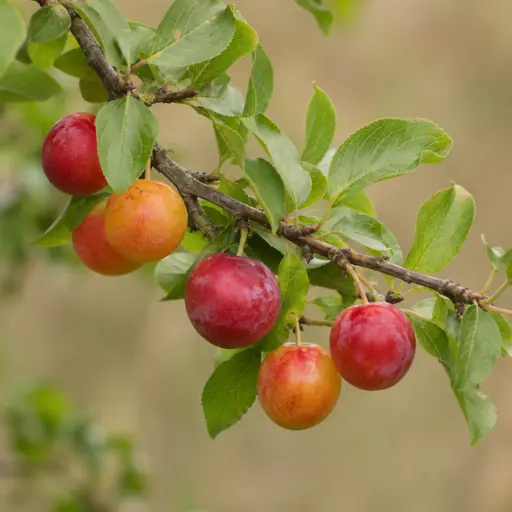
A small, thorny tree with early white blossom and round plums in yellow, orange or red. It has gone wild along roadsides, hedges and creeks in Australia and New Zealand.
How to recognise it
Cherry plum is a bushy tree or large shrub, up to about 8 m tall. Wild ones often have several stems and form thickets. The branches carry thorns, mostly low down. The leaves are egg-shaped with fine teeth. They are 3 to 7 cm long and sit on very short stalks. On most trees they are green. On some they are purple. The white flowers open in late winter, before most other fruit trees. The fruit is round, 2 to 3 cm across and has no hair. It ripens from yellow to orange, red or dark crimson. The ripe flesh is sweet and juicy around one stone. Purple-leaved garden trees are the same species. Their dark red plums are edible too. Garden plums have bigger fruit. Sweet cherry has darker fruit and leaves on much longer stalks. Cherry laurel is the look-alike to avoid. It is evergreen with big, glossy, leathery leaves and clusters of dark purple fruit. The plant is poisonous.
Where it grows
It grows along roadsides and fences, in hedges, on the edges of bush and beside creeks and rivers. It came from the Balkans and western Asia. People brought it to Australia and New Zealand as a garden tree. Birds spread the fruit, so it has gone wild. In Australia you see it most in the cooler south-east, in New South Wales, Victoria and South Australia. It also grows in the south-west of Western Australia. In New Zealand it grows on forest edges, stream banks and dunes. In both countries it counts as an environmental weed.
When
The fruit ripens in summer, mostly from December to February. The white blossom comes first, in August and September. A ripe plum is fully coloured, sweet and juicy. Wild fruit is often small and tart, so taste one before you fill a bag.
Picking
Pick ripe plums by hand and take only what you will use. Leave plenty for birds and other people. The branches are thorny, so reach in with care. It is a weed, so never carry stones or seedlings to a new place. Skip trees that have been cut back and painted with weedkiller. Ask first on private land. Picking is not allowed in national parks. On New Zealand conservation land you need permission from the Department of Conservation.
Cooking
Taste a plum first. Ripe ones are good raw. Tart ones are better cooked. Wash the fruit and take the stones out before you cook. Simmer the plums with sugar and lemon juice for about 20 minutes to make jam. They also make sauce, syrup or fruit leather. Never crush a stone or eat the kernel inside. The kernels and young shoots contain amygdalin and prunasin, which release cyanide. The leaves can be toxic too.
Keeping
Ripe plums are best within a few days, kept in the fridge. Stoned fruit freezes well. Jam keeps in sterilised jars in a cool, dark place.
Sources: Identification and range: WeedScan, NZ Plant Conservation Network, Flora of New Zealand and Weeds of Melbourne. Look-alikes: Weedbusters and Environment Canterbury. Picking and jam: Diego Bonetto. Stones: Plants For A Future. Purple-leaved forms: Royal Horticultural Society. Season: GBIF records.
Always consult an expert before consuming any wild food. This information is for educational purposes only.