

Bunya Nut
Araucaria bidwillii
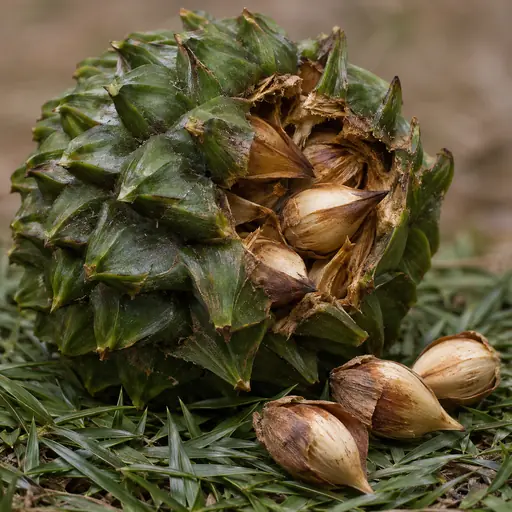
The big, chestnut-like nut of the bunya pine, a tall tree with sharp, glossy leaves and heavy cones. It comes from south-east Queensland and is planted in parks and gardens in Australia and New Zealand.
How to recognise it
The bunya pine is among the tallest trees around, often 30 to 45 m. It has a dome-shaped crown and one straight trunk with dark, knobbly bark. The branches grow in rings around the trunk. The leaves are flat, glossy and dark green, about 5 cm long and sharp at the tip. They spiral around the branch. Young trees are very spiky and look like Christmas trees. The female cone is as big as a football or bigger and weighs up to 10 kg. It is green and made of sharp scales. Each cone holds 50 to 100 nuts. A nut is 2.5 to 5 cm long and sits in a tough, buff-coloured shell. A tree carries cones about once every three years. It starts at around 15 years old. Hoop pine, Norfolk Island pine and Cook pine look similar. They have much finer leaves. Their cones are much smaller and break apart on the tree.
Where it grows
It grows wild only in south-east Queensland. The main stands are in the rainforest of the Bunya Mountains and the Blackall Range. People have planted it far beyond that. You see it in parks, botanic gardens and old homestead gardens from Queensland to Victoria and around Perth. In New Zealand it is planted in the warmer parts, such as Auckland. The bunya is deeply important to the Aboriginal peoples of south-east Queensland. In big crop years clans came from far away to the Bunya Mountains and the Blackall Range. They feasted, traded and held ceremonies there.
When
The cones fall from January to March, about a year and a half after pollination. A tree carries a heavy crop only about every three years. Trees are not in step with each other. Some years you find very little. From November, watch the trees to see which ones carry big cones.
Picking
Never stand or sit under a bunya pine in cone season. A cone can weigh up to 10 kg and drops from high up. Look up before you go near. Leave the tree alone while it still holds cones. Don't climb it. Gardens and parks sometimes rope off the ground below, so respect the ropes. Picking is not allowed in national parks. For trees in parks and streets, check the council's rules first. Take what you need and leave some for others.
Cooking
Raw, the nuts are grainy and bland, so always cook them. First open the cone. Dry it for a week or two, then wear gloves and pull the scales apart. Cut a deep slit in each nut shell, or the nut can burst. Boil the nuts in their shells for about 30 minutes. Or roast them at 180 to 200 °C for 15 to 30 minutes. Peel the shell once they are cool. The nut tastes like a mild chestnut or potato. Use it in soups and stews in place of potatoes. It also works in pesto in place of pine nuts. Roasted and ground, it makes a gluten-free flour for bread and biscuits. The red cooking water makes a tea.
Keeping
Nuts keep best inside the whole cone. Shelled raw nuts go mouldy at room temperature. Fresh nuts keep a week or more in the fridge. Boiled in the shell and frozen, they keep for a year or more.
Sources: Identification and range: ANPSA, Gymnosperm Database and Wikipedia. Look-alikes, cones and cooking: Bush Food Forager. Cooking and safety: Jerry Coleby-Williams. Bunya feasts: State Library of Queensland and Koori History. Ropes and fences: Australian Botanic Garden Mount Annan. National parks: NSW National Parks. Season: GBIF records.
Always consult an expert before consuming any wild food. This information is for educational purposes only.