

Coral Tooth
Hericium coralloides
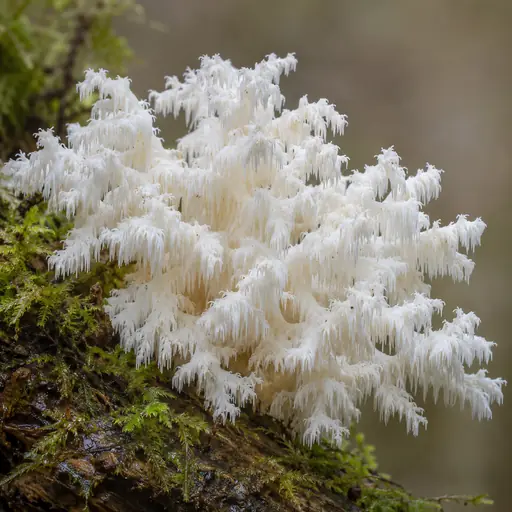
A white, branching fungus with soft spines hanging from every branch like icicles. It grows on rotting logs and dead trees in the forests of Australia and New Zealand.
How to recognise it
It forms a white, much-branched mass, usually 5 to 20 cm across. It has no cap and no gills. Soft spines 5 to 15 mm long hang from the branches in rows. The flesh is white and soft. The spore print is white. With age the spines turn cream, yellow or brown and the branches go brittle. In New Zealand it is called pekepeke-kiore. There it is now named Hericium novae-zealandiae. It is a smaller, more tufted form with shorter spines. Coral fungi such as Ramaria have thicker branches and no hanging spines. Some of them upset the stomach. Coral tooth grows only from wood, never from the ground.
Where it grows
It grows only on wood. Look on fallen logs and standing dead trunks in forest. In New Zealand it often grows from a wound in a living native tree or on old, storm-damaged trees. It grows on beech, kāmahi and other broadleaf trees. The wood is often well rotted. The trunks are often more than 30 cm wide. In Australia it is known from Queensland, New South Wales, Victoria and Tasmania. In New Zealand it grows throughout, mostly in lowland forest of podocarps and broadleaf trees.
When
It is an autumn and winter mushroom. Records run from February to July. Most come in April, May and June. It likes cool, damp weather, especially after a long wet spell.
Picking
Cut off only part of it and leave the rest to keep making spores. Never take every fruit body from a patch. In New Zealand it is a taonga species and not especially common, so take little. Picking is not allowed in national parks. On New Zealand conservation land you need permission from the Department of Conservation. Elsewhere check the local rules first.
Cooking
Once you're certain of it, cook it. Pick young, white ones. Older ones with yellowing spines can turn bitter. Fry it in butter until it has a golden crust. Add garlic and lemon, or stir it into pasta, risotto or chowder. The taste is mild and sweet, a little like crab or lobster. Early records list pekepeke-kiore as an edible fungus. Few accounts of how Māori ate it survive.
Keeping
It is soft and fragile, so cook it within a day or two. Keep it in the fridge in a paper bag until then.
Sources: Identification and habitat: One Hundred and One Forest Fungi of Eastern Australia (Lucidcentral), Hidden Forest, Landcare Research and mycologic.nz (New Zealand), MykoWeb, Zombie Myco and Wikipedia. Cooking: ABC News and mycologic.nz. Māori records: Landcare Research (Rauropi Whakaoranga) and Science Learning Hub. Picking rules: Gourmet Traveller, mycologic.nz and the Department of Conservation. Season: GBIF records.
Always consult an expert before consuming any wild food. This information is for educational purposes only.